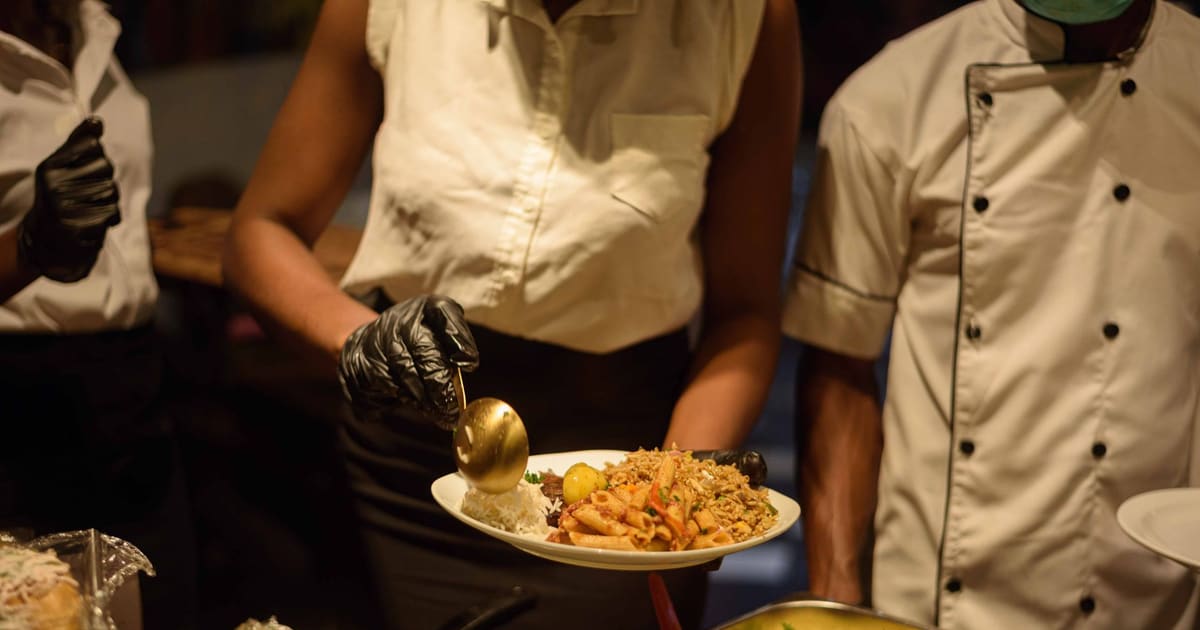
Buffet catering typically costs $45 to $95 per person, while plated dinners run $90 to $175 or more, according to Thumbtack consumer cost data and HomeAdvisor project estimates. The gap is real but narrower than most hosts expect -- buffet food-quantity requirements and station equipment costs offset much of the labor savings. Whether buffet or plated is cheaper for your event depends more on guest count, menu proteins, and service hours than on format alone.
What Each Format Actually Costs
The per-person figures you see quoted for buffet and plated service reflect the same basic categories -- food, staffing, and equipment -- but weighted very differently. Understanding where each style spends helps you predict which will be less expensive for your specific event before you collect a single quote.
| Cost Driver | Buffet | Plated |
|---|---|---|
| Typical per-person range | $45 -- $95 | $90 -- $175+ |
| Staffing ratio | 1 server per 25-40 guests (stations only) | 1 server per 8-12 guests (full table service) |
| Food quantity needed | ~1.5x plated portions (waste buffer) | Controlled per-plate portioning |
| China and rentals | Single plate, simpler glassware | Full place setting per course, more glassware |
| Formality level | Casual to semi-formal | Semi-formal to black tie |
| Best for | Large events, casual celebrations, corporate | Weddings, galas, formal dinners |
| Where it often costs more | Premium proteins at scale; action stations | Every event -- labor dominates |
Ranges are drawn from Thumbtack catering cost data and HomeAdvisor/Angi catering project estimates as of 2024. Actual prices vary widely by city, caterer, and season.
These ranges do not include bar, service charge, or tax
Both buffet and plated quotes are typically food-only. Bar service, the 18 to 24 percent service charge common across full-service caterers according to The Knot's annual catering cost data, and sales tax all apply on top. A plated quote at $120 per person can become $175 or more all-in; a buffet at $70 per person can land at $110. Compare fully loaded numbers, not per-person food headlines.
For a broader look at how these figures fit into total catering spend by event type, How Much Does Catering Cost Per Person? covers the full spectrum from drop-off catering through formal seated dinners.
Why Plated Catering Costs More
Staffing is the primary reason plated dinners command a premium. The National Restaurant Association reports that labor represents 30 to 35 percent of total catering revenue on average -- and that share rises sharply for plated events. A plated dinner for 100 guests typically requires eight to twelve floor servers, a captain, and often a kitchen plating assistant to ensure courses go out simultaneously. Each of those staff members is paid for a minimum shift -- usually five to six hours including setup and breakdown -- regardless of how long active service actually runs.
Thumbtack catering project data suggests that staffing alone accounts for $20 to $45 per person more in a plated event versus a comparable buffet, before food costs are even considered.
The service window also runs longer. A plated three-course dinner moves in discrete rounds: appetizers, then a pause, then entree service with re-filling and clearing, then dessert service. Each pass requires the full floor team to move in coordination, extending the active service window and the corresponding labor clock. A buffet, by contrast, compresses most of that into the initial period when guests are loading plates and then trail-off replenishment.
China and rental costs add a smaller but meaningful premium for plated service. A plated dinner requires a full place setting for each course -- salad plates, dinner plates, soup bowls, dessert plates, and the corresponding flatware for each. The glassware count (water, wine, champagne) multiplies as well. According to HomeAdvisor/Angi project data, rental costs for a plated dinner run $10 to $20 per person more than a comparable buffet, which uses simpler single-plate settings at the station.
One genuine cost advantage of plated service is portion control. When a chef plates each dish individually, food cost is precise -- 6 ounces of protein per guest is 6 ounces per guest, no more. That tightness reduces food waste and makes the food-cost line predictable. Buffet format forfeits that control almost entirely.
Why Buffet Is Not Always Cheaper
The assumption that buffet automatically saves money is one of the most consistent misconceptions in event catering. Under certain conditions, a buffet can approach or exceed the all-in cost of a plated dinner.
Food quantity is the biggest hidden cost. Self-serve buffets require significantly more total food than a plated event of the same size. When guests control their own portions, food intake is unpredictable -- some guests take small amounts and return for seconds; others load their plate once heavily; attendance at the buffet table is uneven across the meal window. Most experienced caterers apply a factor of 1.2 to 1.5 times the plated portion calculation to buffet events, per HomeAdvisor/Angi catering guidance. For a 100-person buffet with a $22 per-person food cost, that safety factor adds roughly $2,200 to $4,400 in raw food cost before a single server is hired.
When your menu features premium proteins -- beef tenderloin, prime rib, whole fish, or shellfish -- this multiplier becomes expensive fast. A buffet carving station of beef tenderloin for 100 guests at a 1.3x buffer costs considerably more in raw protein than 100 precisely portioned plated filets. This is why high-end wedding caterers often recommend plated service for menus anchored around expensive cuts: the portion control justifies the extra labor cost.
Station equipment adds up. A buffet is not just food on a table. Professional buffet service involves chafing dishes with fuel cells, carving stations with heat lamps, sneeze guards, serving vessels, and often an attendant at action stations (carving, pasta, or crepe stations). Rental and setup costs for full buffet station equipment can run $8 to $18 per person, per HomeAdvisor/Angi estimates, depending on the number of stations and whether the caterer owns the equipment or subcontracts rentals.
Action stations -- where a chef works a live station such as a pasta bar or carving station -- add labor back in at a meaningful rate. A pasta station at a 120-person event might staff two cooks for four hours. The labor cost of those station attendants narrows the buffet-vs-plated staffing gap considerably.
The "buffet is cheaper" assumption can blow your budget
Before committing to a buffet because you expect it to save money, ask your caterer for a fully itemized food cost that includes their portion multiplier, station equipment rentals, and attendant labor for any action stations. Then compare that total to a plated quote. For menus with premium proteins and more than two action stations, the gap may be smaller than you expect.
Guest Experience Tradeoffs
Cost is only one dimension of the buffet-vs-plated decision. How each format feels to guests -- and what logistical demands it places on the room -- matters just as much for event satisfaction.
Plated service signals formality. A plated dinner sets a tone: guests are seated, courses arrive, and the meal has a pacing and a structure. That formality is appropriate for black-tie galas, traditional weddings, and corporate dinners where the meal is itself part of the event's purpose. The Emily Post Institute cites plated, full table service as the standard for formal seated events where host hospitality is paramount. Guests do not have to navigate a buffet line or decide whether to return for more; the meal comes to them.
Buffets favor mingling and flexibility. Guests control when they eat, how much they take, and how long they spend at the table. That flexibility works well for celebrations where socializing is the primary goal -- cocktail-style receptions, graduation parties, corporate networking events, and informal weddings where guests are expected to move around the room. The lack of table-service pacing also means the event timeline is less rigid: guests can graze over a longer window without the caterer driving the schedule.
Dietary accommodations are easier to manage at a buffet. Labeled stations with allergen information let guests self-select without requiring the kitchen to track every seat. Plated service handles dietary restrictions through pre-ordered alternates -- the team must know which guests receive which plate and deliver it correctly. Either system works; buffet labeling is simply easier to execute at scale.
Pacing and timeline differ significantly. A plated three-course dinner for 150 guests might run 90 minutes from first course to dessert. A buffet of the same headcount, with a single serving line, may have 40 to 60 guests queued simultaneously during the first wave. Multiple stations, a staggered table-release system, and adequate serving-line length all help -- but they require planning and sometimes extra staff.
Stagger buffet table releases to prevent line congestion
Ask your caterer about a staggered release: tables 1-5 go first, then 6-10, spaced about five minutes apart. This prevents the mid-event pile-up that is the most common guest complaint about buffet format. Most experienced caterers do this automatically; if yours does not mention it, ask.
The Hybrid Option: Family-Style Service
Family-style catering sits between buffet and plated on both cost and formality -- and it deserves more consideration than it typically gets. In family-style service, large platters and serving bowls arrive at each table and guests pass them around, serving themselves at their seats. No buffet line, but no individual plating by servers either.
The staffing requirement for family-style falls between the two formats. Servers still need to deliver and clear platters, refill beverages, and attend to the table -- but the kitchen does not plate 150 individual dishes, and servers are not running course-by-course passes to every seat simultaneously. The practical effect is a labor cost roughly $15 to $25 per person above a well-run buffet but $15 to $30 below full plated service, based on Thumbtack catering project data.
Family-style tends to work best for medium-sized events (40 to 150 guests) where the host wants a social, convivial atmosphere without the informality of a buffet line. It is a natural fit for weddings with a farm-table aesthetic, corporate team dinners, and anniversary celebrations where shared platters feel hospitable rather than casual.
For wedding-specific planning, Wedding Catering Cost Per Person: What to Budget covers how buffet, family-style, and plated catering fit into the full wedding food budget, including bar and service-charge considerations.
When Buffet Wins, When Plated Wins
The right format for your event is rarely about which one costs less in the abstract -- it is about which one delivers the guest experience you want at a price that fits your fully loaded budget.
Buffet is the stronger choice when:
- Your event has more than 100 guests and a casual or semi-formal tone. Buffets scale efficiently and suit gatherings where mingling matters more than formal pacing.
- Your menu is not protein-heavy. A buffet of chicken, vegetarian entrees, salads, and sides does not trigger the oversupply problem that expensive proteins create.
- Your venue has adequate space for multiple stations with natural guest flow between them.
- Budget flexibility is limited and you are willing to trade some formality for a lower all-in number.
Plated is the stronger choice when:
- Formality and pacing are core to the event -- a corporate gala, traditional wedding reception, or milestone anniversary dinner where the meal is the event, not just the backdrop.
- Your menu features premium proteins. Portion control is precise at plated service; a buffet carving station with prime rib requires more raw protein than an equivalent plated cut.
- Your guest list is small to mid-sized (under 150 guests), where the per-person staffing cost is manageable and logistical complexity is easier to coordinate.
- You have guests with complex dietary restrictions that benefit from pre-assigned, seat-tracked alternates.
"Buffet is always cheaper" is a myth
For events with premium proteins, multiple action stations, or a smaller guest count, buffet and plated catering often land within $10 to $20 per person of each other all-in. The decision should be made on guest-experience and logistical fit first, with cost as a confirming factor rather than the sole driver. Get fully itemized quotes from your caterer for both formats and compare the complete totals.
What to Ask Your Caterer Before You Choose
Once you have a sense of which format fits your event, a few targeted questions will tell you whether the cost difference is real for your specific situation.
For buffet quotes: Ask how the caterer calculates food quantities for buffet service. A good answer includes an explicit portion multiplier (1.2x to 1.5x is standard) and a breakdown of station equipment costs. Ask whether action stations are staffed and how that labor is billed.
For plated quotes: Ask for the staffing ratio and the total number of servers, the captain, and any kitchen staff included in the per-person price. Ask whether a service charge is already included or added on top. Confirm what the china and linen situation is -- owned by the caterer, or rented separately.
For both: Ask for a fully itemized written proposal that includes food, staffing, equipment, service charge, tax, and any delivery or setup fees. Then compare the totals, not the per-person headlines.
If you are also weighing whether a caterer is the right fit at all for a smaller gathering, Caterer vs Private Chef: Which Is Right for Your Event? walks through how both options compare across headcount ranges and service styles.
The best format is the one that matches your guests, your venue, and your total budget -- not the one that looks cheapest in a first-line quote.
Frequently asked questions
Is buffet or plated catering cheaper?
Buffet catering typically costs $45 to $95 per person, while plated dinners run $90 to $175 or more, according to Thumbtack and HomeAdvisor data. But buffet is not always the cheaper option -- it requires more total food prepared (roughly 1.5 times a plated portion) to prevent running out, and station equipment adds costs that narrow the gap significantly at larger events.
How much more does plated catering cost than buffet per person?
Plated service typically adds $25 to $60 per person over a comparable buffet, driven almost entirely by staffing. A plated dinner for 100 guests needs approximately one server per two to three tables; a buffet of the same size might need half as many floor servers. That labor difference is the primary cost gap between the two formats.
What is family-style catering and how does it compare in cost?
Family-style catering places shared platters on each table and lets guests serve themselves, similar to a restaurant-style meal. It typically costs $70 to $130 per person -- between buffet and plated -- because it requires fewer servers than plated service but more controlled portioning than a buffet. It is a popular middle option for weddings and corporate dinners that want formality without the full plated price.
Why does plated catering cost more than buffet?
Three factors drive the plated premium: more servers (roughly one per two to three tables vs. far fewer for buffet stations), longer active service windows (servers make multiple passes for each course), and higher china and rental costs (each place setting requires full course-specific glassware and flatware rather than a single plate at a buffet). Portion control is also tighter, which slightly reduces food waste compared to a self-serve format.
Can buffet catering cost more than plated?
Yes, under specific conditions. Very large buffets require significant station equipment -- chafing dishes, carving stations, sneeze guards, and attendants at action stations -- that can rival the staffing cost of a plated event. The food-waste factor (buffets require 20 to 30 percent more total food prepared to avoid running out, per HomeAdvisor estimates) also narrows the gap when serving premium proteins like beef or seafood.